June 19, 2026
I'm building author ad templates from 2-year old crime book ads. Follow along.
I am building author ad templates by analyzing crime book ads that have been running for at least two years. You can follow my process and the logic behind why these specific creatives survive while others fatigue.
If you run Facebook ads, you have likely seen your creatives die out much faster than they used to. We are constantly forced to refresh images and copy to maintain performance. However, there are outliers.
I went into the Facebook Ads Library to find ads that have stayed active since 2022. I believe in something I call learning by exposure. This is the process of trusting your brain to pick up patterns simply by looking at what works over and over again.
These ads are the survivors. Even after the Andromeda updates that forced most authors to pause old creatives, these specific ads stayed live. We have to assume they are profitable. I want to map out the exact mechanics of these ads so we can adapt the lessons for our own templates.
The Image Hierarchy and Visual Direction
The ad creative is usually 70 to 80 percent of the success of the entire ad. I always start my analysis with the image and move to the copy later.
In this specific crime ad for a book called The Family Man, the image relies on a strong mood. It shows a character looking away from the camera in a dark, rainy setting. There is heavy visual contrast between the dark background and the high-contrast yellow text. This is a deliberate choice because contrast is the primary mechanism for stopping the scroll in a busy feed.
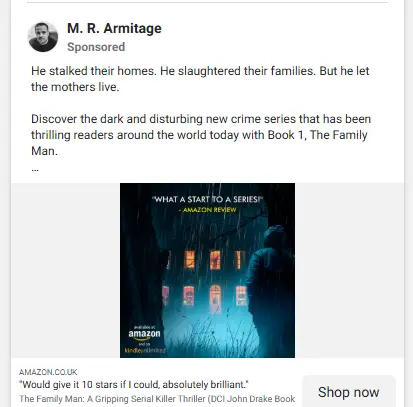 The image also utilizes direction. It points the viewer's eyes toward a story element or a specific character. When you give instructions to a designer, you should assume the eye lands in one specific spot first.
Managing the design requires you to guide the person from that initial landing point to the next logical piece of information. In this case, the image points the eyes towards the story elements rather than just being a static picture.
The First Line and the Open Loop Logic
The first line of the ad copy carries the weight of the hook, and I’d argue the first line is the most important part of the ad, second only to the image. Anyway, this ad starts with: "He stalked their homes. He slaughtered their families, but he let the mothers live."
This works because it creates a perfect open loop.
A closed loop is a statement of fact that satisfies curiosity. An open loop is a hook that creates a gap in the reader's mind. When you read that a killer slaughters families but leaves the mothers, your brain demands to know the reasoning. You feel forced to click the read more button to close that loop because that is the only way to resolve the tension.
The first line also collaborates directly with the image. They are connected entities that work together to tell a cohesive story. The image sets the atmosphere and the text provides the high-stakes narrative.
Explicit Genre Signaling and Keyword Weight
You must be explicit about your genre to help the algorithm find your readers. This ad uses heavy, genre-defining keywords like "dark," "disturbing," and "gripping serial killer thriller."
For your ads, look for single words/phrases that carry genre weight for your specific audience. For example, the word "angst" signals everything a dark romance reader needs to know. In a cozy mystery or romantic comedy, a word like "cute" signals a peaceful and safe reading experience.
This ad is also very overt about its target audience by mentioning Kindle Unlimited in high-contrast yellow. This signals to the reader that the book is accessible to them immediately. If you are looking for collectors, you could use terms like "special edition" to trigger that same recognition. By using the term Kindle Unlimited in the image, you are pre-qualifying the click and telling the reader this is specifically for them.
Link Display and Headline Contrast
The headline of the ad uses social proof as an anchor: "Would give it 10 stars if I could."
There is also a technical nuance in the link display. On Facebook, you can customize both the actual link and the display link. This author chose to make the display link all caps. This creates visual contrast against the headline and makes the entire block stand out. This is an intentional way to create a structural break in the feed that draws the eye downward toward the call to action.
Reinforcing the Premise through Gap Selling
I analyzed how the book's blurb on Amazon compares to the ad copy. The first sentence of the blurb reinforces the exact premise set in the ad.
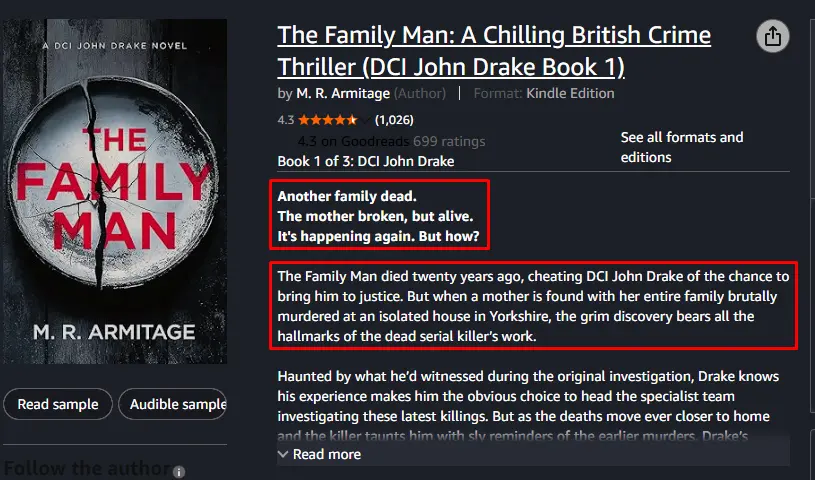 It mentions the broken mother and asks how it could be happening again.
That first paragraph is a gap-selling technique.
In gap selling, you create a gap between the present situation (status quo) and a future desired state. In this case, the status quo to the reader is “ a family is dead, the mother is left alive but devastated.”
The right reader will already be pulled in but not yet sold, because at this point, there’s nothing special about the premise. Then an extra, tiny bit of detail is added: “this type of murder has happened before, and for some reason the reader is yet to know, it shouldn’t be possible.”
With that line, a future desired state is created in the buyer’s mind. That is, finding out why it shouldn’t be possible for this type of murder to happen again. The second future desired state for the reader is figuring out how the murder that shouldn’t be possible happened.
And the desire to fill the gap is what is expected to pull the reader through the buying process all the way to checkout. Any other text that follows this part of the blurb is just there to widen that original gap.
This works well with the original ad cause the author already created a mystery and then repainted that feeling the moment a potential reader landed on the product page. This builds on the curiosity in the Facebook ad rather than resetting it.
The blurb then goes on to introduce the protagonist, DCI John Drake, and adds a new loop regarding a mistake he made twenty years ago (which is another gap).
By the time the reader finishes the blurb, they have multiple unresolved questions. They want to know why the killer leaves the mothers alive, and they want to know what the detective’s secret mistake was.
If the reader clicks away without buying, they feel a sense of loss from not knowing the outcome. And that’s the heart of gap selling. (I’ve recorded a video on Gap Selling; will link it here when that goes live.)
Building the Muscle of Pattern Recognition
I am curating a massive list of these ads to help you internalize these patterns. I have already mapped out over 100 romance ads with similar commentary, using arrows to point to the specific first lines and image logic that make them work.
The goal is to turn this into a muscle. When you look at enough successful, long-running ads, you stop guessing and start building based on operational reality. This crime ad is simple, but it is effective because it creates a gap that the reader feels a psychological need to fill.
I will keep digging into these two-year-old ads to see what else has survived the fatigue of the modern Facebook algorithm. Here’s the final spreadsheet with the lessons from this ad adapted into templates you can use.
PS: I believe in cross-training, using techniques from seemingly unrelated spaces and adapting them for your genre or industry. So if you plan to create book ads but have trouble figuring out how to structure hooks, first lines, imagery, the lower-third (headline, call to action, and description), etc...
I curated 107 romance ads and added commentary for each section to show you what works and why. Romance authors are some of the most aggressive marketers in fiction, so you'd do well seeing what they are up to.
Authors from all niches are using it to learn by exposure. For example, you see romance authors using trope maps in interesting ways. On the other hand, I have never seen action thriller or crime book ads leveraging trope maps, even though we do have entrenched tropes. Why not? Get it here: Romance Ads Swipe File.