June 15, 2026
How I Do Genre Signal Mining: A Cozy Mystery Case Study
The reality of advertising on Facebook has changed fundamentally for those of us deep in the system. Facebook no longer supports the interest-based targeting that authors relied on for years. While a few targets remain, the reliable comp author interests have largely disappeared. I know this is because the new Andromeda algorithm has shifted the burden of targeting onto the creative itself. The creative is now the primary signal used to find readers who will love a book.
If I run broad targeting or use the few interests that remain, I have to do some heavy lifting with my creative. I cannot allow my creative choices to be random or based on a vague feel. I need data.
Creative people are often arrogant, and I include myself in that group. I often think what I know is the absolute truth, but when I actually sit down to read reviews and mine data, I realize people are so different that I must rely on objective data to capture insights I would otherwise miss. I call this process Genre Signal Mining.
The Mechanics of the Mining Session
The goal is to figure out which keywords, names, emotions, and settings represent a specific genre. I look for signals that help the Facebook algorithm identify a book. For this session, I went to the Facebook Ad Library and Goodreads reviews. I began by looking at what the dominant authors in the cozy mystery niche are doing. I searched for Janet Evanovich and A.R. Winters. Even when I am new to a genre, I find who is dominating by seeing who other authors quote in their ads or who readers mention on social platforms.
In the Facebook Ad Library, I looked for genre identifiers trope and tone phrases like, "private investigator," "small town," etc.
I tracked this in my spreadsheet because it removes my ego from the process. I ignore my personal preferences and focus entirely on what is already working in the wild. I also identified indie authors being used as comps by other successful advertisers, specifically Amanda Lee, Richard Osman, and Steve Higgs. You would normally never think of these names, but other advertisers have already done the work of finding them for you.
In some niches, it is hard to find reader sentiment on Facebook because the platforms are mostly active for romance. For other genres like action thrillers, you find next to nothing. This is why I use Goodreads to find the specific technical language readers use to describe their experience.Categorizing the Live Data
When I mine these signals, I look for the experience of consuming the book. I broke these findings down into specific columns in my master spreadsheet.
-
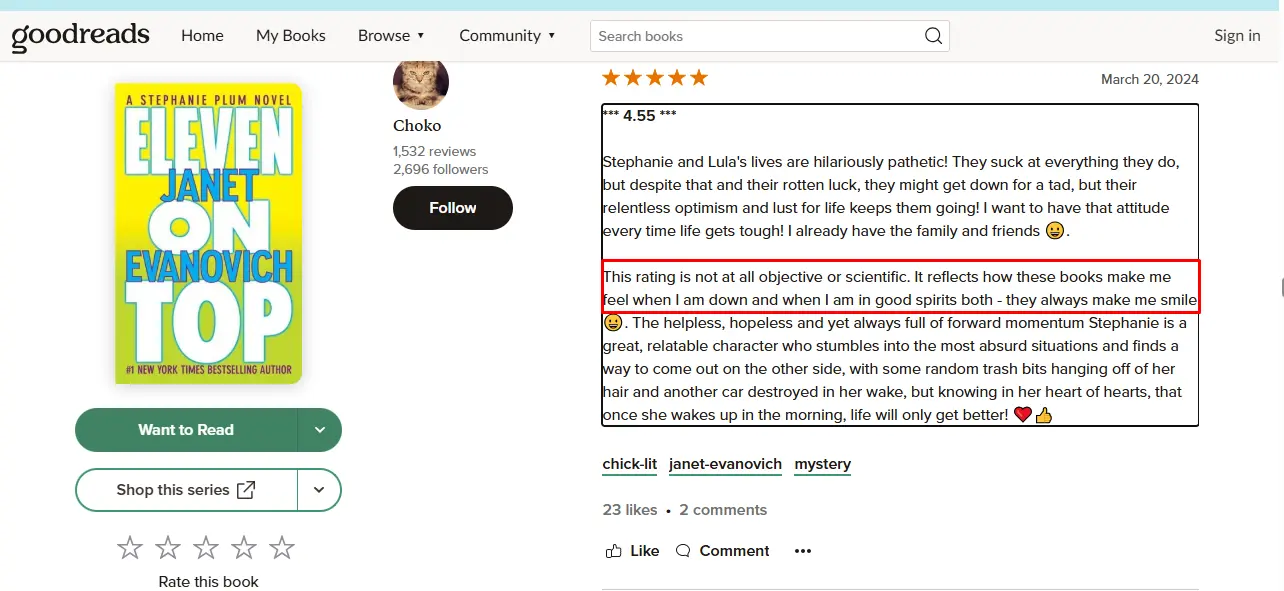
The Experience of Reading. I found phrases that describe how a reader feels while they are in the book. This includes descriptors like fast paced, easy reading, and books you can read in one sitting or in a single day. On sites like Reddit and Goodreads, I found people specifically searching for books with great banter or top quality bickering. These are the identifiers that tell the algorithm exactly who to look for.
-
Emotional Triggers. A book is essentially emotions packaged in paper or a Kindle file. In my romance mining, I found signals like angst and revenge. In this cozy mystery session, I noticed the word cute appeared multiple times in the reviews. I would never personally use the word cute to describe something I am writing because that is just not how I talk. By putting away my assumptions and using the spreadsheet, I captured the signal that helps Facebook find the audience that specifically craves a cute mystery.
-
Environmental Signals. Sometimes the setting is the strongest signal. I have seen authors build eight book series based entirely on a Florida setting or an Irish countryside. Certain readers are looking for a sunny summer or a coastal Florida vibe. These are the data points I put into my primary text to help the machine find the right people.
Finding Insight in Mass Reviews
There is a danger in only using the Facebook Ad Library. If I only look at what other authors are doing, I risk regurgitating the same ideas and fighting for the same 10 percent of the market that is ready to buy right now. The other 90 percent of the market might respond to a specific emotion or setting found in the reviews.
I prefer mining reviews on Goodreads because it is easier to scrape than Amazon. I take the raw sentiment from hundreds of reviews and feed it into a synthesis tool to find patterns.
If an alien walked up to me, held up an alien gun to my temple, and told me to attract cozy mystery readers with keywords other than the popular category keywords, my data mining would save me. It produced several functional substitutes for the word mystery. I found phrases like red herrings and twists that readers associate with the genre. I also found tone specific keywords like charming atmosphere or sweet and endearing personalities. The goal is to find terms and emotions that act as genre signals for both the algorithm and the reader.
Translating Signals into Creative
Once I have these signals, I turn them into images. In modern Facebook advertising, the image does about 80 percent of the heavy lifting. If the central emotion I want to sell is captured in the primary text but not the image, I lose efficiency.
I observed that A.R. Winters does this well. She uses images that perfectly match the quirky and funny tone of her books. One image features a cat and a woman with identical facial expressions. Even without the text, the image communicates that the book is funny and addictive.
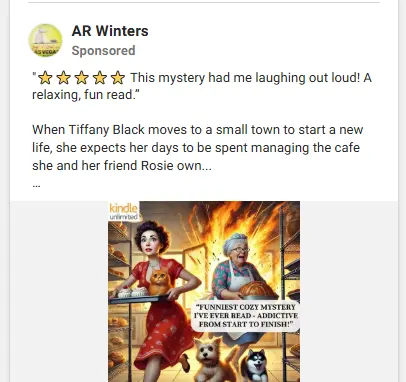 PS: this image has been running since February 2026 and I'm publishing this in July. The image packs in cozy mystery tropes (baking, dogs, older character), and is overt about its tone. And just in case you hadn't gotten the point. It drives it home with the quote that reinforces the genre and tone.
When making creatives, if I have five different mined keywords that capture different emotions like sweet, sad, or funny, action packed... I'd create five different images that express those specific signals. This would capture five different buckets of people who want to experience those emotions. This reduces the risk of not finding the right people. So the keywords you mine should tie all the way to your ad image in that someone could look at an image and that keyword rings true without you having to mention it.
The Hook Framework and the Algorithm
While mining, I also look for universal hook structures. These are the first lines that earn the click. I found a specific example in the wild while doing this session: When a grieving detective is transferred to a beautiful island, he soon finds himself knee-deep in sand and murder.
There is a saying in Kenya that the day you decide to walk naked is the day you meet your in-laws. I stumbled upon this specific hook framework while I was browsing live, and it is a gem that works across almost any industry. The structure is: when X does Y, J happens.
I keep a list of these frameworks in my template:
- When a single dad loses X, X happens.
- When an elite paramilitary member discovers a conspiracy, his family becomes the target.
- When an assassin decides to retire in a small town, a local disappearance forces him back into the life.
The first line is everything, but the rest of the copy does the heavy technical work. I put up to 250 words in the description field on Facebook. Even if the reader only sees the first sentence, the algorithm reads every single word in that block to determine who should see the ad. Using these 250 words as a net of keywords and signals is how you guide the machine to your audience.
Why Data Beats Intuition
I use this same logic in the cold email world. In cold email, if I send a bad message, I get an instant response telling me to fuck off. To protect my reputation and my domain, I have to dig for the voice of customer data so that my first line resonates immediately.
In ads, people do not usually tell me to go away. Instead, I just lose money. Losing money is the Facebook version of being told to fuck off. Stumbling upon the data when you are looking for it is how you avoid that embarrassment in your marketing.
By doing genre signal mining, I am putting away my assumptions and building a library of data that is already proven to work. It allows me to write from a place of knowledge rather than a place of arrogance. You should start by looking for the signals you have been ignoring because they did not fit your personal vocabulary.
PS: I believe in cross-training, using techniques from seemingly unrelated spaces and adapting them for your genre or industry. So if you plan to create book ads but have trouble figuring out how to structure hooks, first lines, imagery, the lower-third (headline, call to action, and description), etc...
I curated 107 romance ads and added commentary for each section to show you what works and why. Romance authors are some of the most aggressive marketers in fiction, so you'd do well seeing what they are up to.
Authors from all niches are using it to learn by exposure. For example, you see romance authors using trope maps in interesting ways. On the other hand, I have never seen action thriller or crime book ads leveraging trope maps, even though we do have entrenched tropes. Why not? Get it here: Romance Ads Swipe File.