June 15, 2026
I Went Through Mafia Romance Ads' First Lines And Put Them In A Spreadheet. Here's Why You Should Do It Too.
The more I am exposed to a specific style of ad writing, the easier it becomes for me to internalise what good is and what bad looks like.
So I recently spent an afternoon in the Facebook Ads Library searching for Mafia Romance and documented the whole session. My specific goal was to collect as many first lines from ads in this genre as humanly possible. I believe that gathering a massive volume of examples allows the brain to recognize what a high-performing hook feels like (cause that’s the sole job of the first line).
In the process, I could feel a point where my brain started to distinguish between what captures attention and what fails to land. If you watch the video, you see it in action as it happens. But for the readers, this article digests that logic for you.
The Technical Reality of the 125-Character Cutoff
I copied these lines into a spreadsheet so I could read them in isolation. The first line is the specific element people see before they click the Read More button. It sells the entire ad in conjunction with the image. In my observation, the image provides about 80 percent of the initial impact, but the first line carries the narrative weight. Studying these patterns improves my ad muscle, my first line muscle, and my hook muscle through pure exposure.
Here's what I'm talking about:
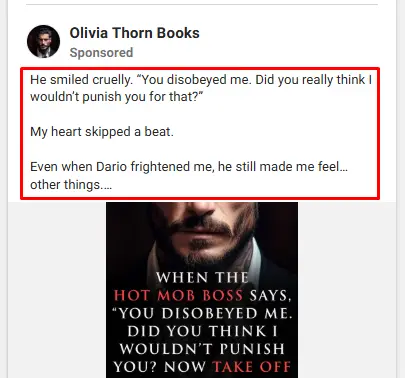
I analyzed the cutoff points for these ads to understand the technical limitations of the mobile format. Most mobile devices cut off the primary text at roughly 125 characters, which is about 20 to 25 words. I looked for the first two lines specifically because that is the total space available to earn a click.
In one example, the ad started with: The baby he snarls, making me flinch. Are you keeping it? This is a hook that establishes immediate conflict. Another successful structure I saw was: Six brothers, six reasons to sin. Even if the author ended the line there, the hook would function. It establishes the scope of the story and the thematic promise instantly.
I noticed that many successful ads use short sentences and intentional spacing. They give the lines room to breathe. One ad used a bold first line followed by a seven-word sentence with a lowercase starting letter. This style leads the reader along and creates a specific rhythm. It feels more like an unfolding story and less like a sales pitch.
Cross-Training and Genre Logic
I use these principles across every genre I work in. If you are writing for a niche that feels dry, you should study romance ads. I view this as cross-training. If a basketball player has trouble with flexibility, they might do karate or yoga to solve the problem. Copywriting works the same way. Romance authors are exceptionally good at hooks because they are hell-bent on capturing attention through emotional stakes.
If you try this, pay attention to romance apps too; specifically because they operate with large budgets and extensive data. Their advertising structures are often different from individual authors. They experiment with different layouts because they have the volume to see what works. These apps provide a technical breakdown of high-level experimentation for anyone looking for variation from their usual routine.
I also observed how authors use their profiles to build authority. One author used a hot mafia character as a profile image instead of a personal photo or a corporate logo. This intrigued me because from the info-products world, we know that personal photos used as the profile photos in accounts have a much higher impact in social feeds than corporate logos. So it's great to see someone do this on a romance pen name where many of us might be tempted to just use an object profile photo to keep our identities safe.
The One-Two Punch of Visuals and Lingo
A powerful hook functions as a one-two punch between the text and the image.
I found an ad that read: “Give me your leg…” “Arsen, I’m wearing a dress.”
The ad image that went with this featured a man in a suit, a mafia romance and billionaire romance trope, holding on to a woman’s thigh with black lace leggings visible.
That bit of detail, and the tone in the first line, combined with the image, hinted at the couple’s dynamic, and thus attracts the right type of romance reader. This pairing creates a cohesive moment that drops the reader directly into a scene.
It's easy to miss, but successful ads often lead with on-genre lingo.
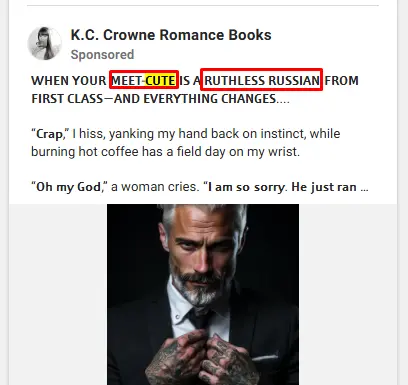
These are words or phrases that make sense to a specific audience but mean nothing to everyone else. The term meet-cute is a prime example. When an ad says, When your meet-cute is a ruthless Russian from first class, it signals to romance readers that this content is for them. This language tells the platform algorithm exactly who the target reader is by using the specific vocabulary of the genre.
I also saw authors using the POV-meme style language, which is social media language rather than sales language. An ad that starts with: POV: You aren't supposed to fall for him, works because it mirrors the way people talk on platforms like TikTok or Instagram. It creates a sense of intimacy and shifts the perspective of the reader into the story immediately.
The Mechanics of Tension
The ads that resonated most with me were those that utilized conflict right away. One example was: Eight years ago, Ivan Dubinin destroyed me. The bratva heir who swore he loved me then vanished. This establishes a timeline, a specific character, a betrayal, and a genre all within two lines.
I found that authors often use a push-and-pull mechanic. One hook read: He was my revenge. I became his obsession. This uses opposites to create structural tension. It forces the reader to wonder how the situation resolves.
 I also noticed a trend of using PSA-style hooks. An ad might start with: Warning: This dark omegaverse will have you up all night. This creates a sense of exclusivity and intensity. The reader often feels forced to click Read More to see what the warning is about.
Building an Internal Barometer
I compiled a list of about 35 lines during this video session that, if need be, you can read every day to get brain familiarized with "hooky" first lines. This practice allows my me to figure out why certain lines hook me and others do not. Even if the logic is not immediately obvious, the constant exposure helps me find the right mood before I start writing my own first lines.
Notice the specific moments an author drops a reader into a scene.One ad used the line: Surprise motherf###. The sound of my palm on his face cracks through the marble elevator. This is a sensory hook. It uses sound and a specific setting to create a mental picture.
By building a separate list of these hooks and studying them outside of the Facebook feed, I can analyze the mechanics of the writing without being distracted by the platform itself. I want to see how a baby (for instance, an heir to a mafia empire) or whatever tropey, hidden secret can be condensed into a few words that stop a scroll.
This is how I stay active and avoid creative stagnation during a slow afternoon. Once you have enough examples, you no longer have to guess what a good hook looks like because you have a spreadsheet full of evidence.
PS: I believe in cross-training, using techniques from seemingly unrelated spaces and adapting them for your genre or industry. So if you plan to create book ads but have trouble figuring out how to structure hooks, first lines, imagery, the lower-third (headline, call to action, and description), etc...
I curated 107 romance ads and added commentary for each section to show you what works and why. Romance authors are some of the most aggressive marketers in fiction, so you'd do well seeing what they are up to.
Authors from all niches are using it to learn by exposure. For example, you see romance authors using trope maps in interesting ways. On the other hand, I have never seen action thriller or crime book ads leveraging trope maps, even though we do have entrenched tropes. Why not? Get it here: Romance Ads Swipe File.